


A Small Grant Scores a Big Sound for Waterbury Symphony Orchestra
As one of Connecticut’s few professional symphonies, the Waterbury Symphony Orchestra’s two main missions have remained constant over the decades: delivering a robust, high-quality season of 10+ concerts and providing educational programming targeting underserved communities, most importantly through its beloved Bravo After-School program, now in its 14th year.
Remarkably, the Symphony has accomplished this with a small-but-mighty team of one full-time employee and a number of part-time employees and contractors. The team used to be even smaller, but through the generosity and support of patrons, funders, and community partners, including Connecticut Community Foundation, the Symphony has doubled its ticket sales and membership over the past three years, while also doubling the number of children served through its educational programming.
Meanwhile, the Symphony has faced some daunting challenges during this time, including the loss of critical educational funding and a sudden physical move necessitated by the COVID pandemic. This move resulted in an upheaval of its storage, office equipment, filing systems, and 88 years of archives, including its treasured music library, which was left scattered across multiple locations.
“After our musicians, one of the most critical assets any symphony has is its music library,” says Donato. “It’s a specialized collection that includes the full scores of all works performed, musical parts for each instrument in the ensemble, and all the arrangements and transcriptions. Rebuilding it has been a priority – it is central to our function, and it also serves as an important cultural archive.”
In response, Executive Director Douglas Donato looked to the community, including Connecticut Community Foundation, for new support to bolster the Symphony’s long-term sustainability.
Donato and WSO’s Strategic Advisor, Douglas Bibbey, formulated a plan and applied to the Foundation for a Strengthening Nonprofits grant. These funds are specifically designed to help nonprofits access the resources needed to build internal capacity and increase their organizations’ sustainability. In its application, the Symphony indicated that the funds would be used to bring in additional temporary, part-time support, as well as to cover costs associated with rebuilding the library.
The impact of this modest $10,000 grant is a testament to the ingenuity of the Symphony’s tight-knit team.
“What the Foundation provided gave us the bandwidth to tackle and complete persistent issues that just couldn’t be handled without that extra boost,” says Douglas Bibbey, a Strategic Advisor for the Symphony. “We then realized that the temporary part-timer support gave us the capacity to also oversee a part-time intern over the summer. We could provide a stipend for our intern and cover the costs of clearing the space and renovating the library. This was all made possible only due to the CCF grant dedicated to building our capacity.”
The grant made other progress possible, too, including a new relationship with a librarian at the Boston Symphony.
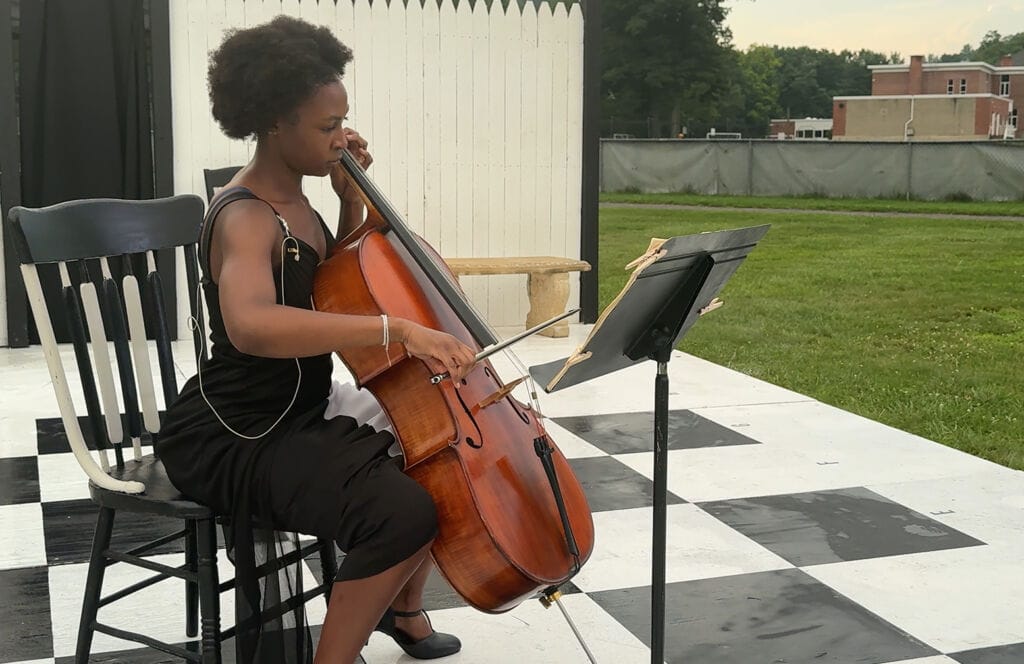
Perhaps the most exciting result was the unanticipated benefit of engaging an intern, Madison Kirkland, a high school senior and cellist from Waterbury who attends Taft School, to support the project.
According to Bibbey, “We found Madison via Taft’s Student Orchestra, with whom the Symphony had a ‘side-by-side’ performance in its Season Finale Concert in May. Madison’s background in music was an enormous asset as we tackled the library project. And, in a wonderful full-circle moment, we discovered that she herself had gotten her start on the cello in our Bravo program as a middle-schooler!”
Madison’s mother, Tangi Kirkland, says the Waterbury Symphony’s Bravo program, which has also been supported through grants from Connecticut Community Foundation, changed the trajectory of her daughter’s life.
“In so many ways, this Strengthening Nonprofits grant has been transformative for us,” said Donato. “Ten thousand dollars doesn’t sound like a lot, but it allowed us to shore up our systems so that we could function properly as a symphony and focus on our core work: the twelve months of programming and youth education that mean so much to our community.”
Kathy Taylor, president and CEO of Connecticut Community Foundation, said, “We are proud to support the Waterbury Symphony and the important role it plays in enriching the cultural life of our community. Having previously invested in the Symphony’s Bravo program and now in this Strengthening Nonprofits effort, we’ve seen firsthand how strategic capacity-building investments can help nonprofits build a stronger foundation for the future. At a time when arts organizations face increasing competition for funding, providing the tools and resources needed to strengthen operations, expand impact, and sustain excellence is more important than ever. The Waterbury Symphony’s commitment to growth and innovation will benefit not only the organization, but our entire community for years to come.”